A restaurant robot earns its place by handling one repeated task safely, around people, during a busy service. Restaurant robots should be judged by that test, not by a polished video or a human-like body.
- Useful work: Move food, carry trays, clean floors, or support stock work without blocking staff.
- Safe movement: Detect people, stop with control, and recover from a small change in its path.
- Clear value: Show the task, running cost, service limits, and the work still needed from people.
Start with the restaurant task
Restaurant work changes by the minute. A dining room has chairs, bags, children, spills, and staff moving through narrow spaces. A kitchen adds heat, steam, wet floors, sharp tools, and strict timing. A robot built for one setting may struggle in another.
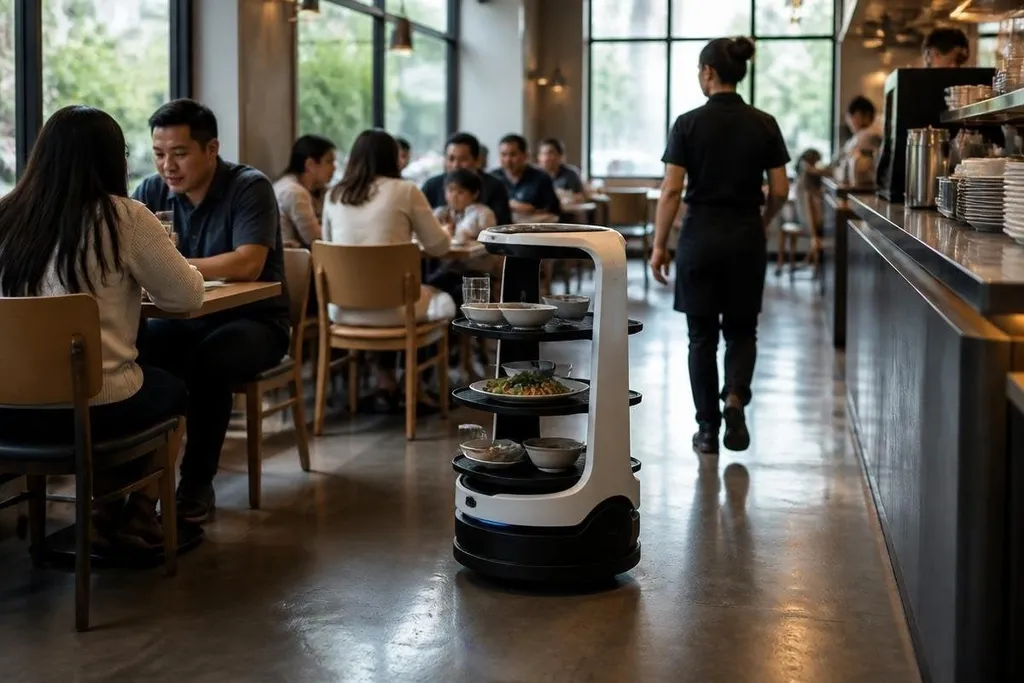
That makes the job more important than the body. A delivery robot needs a stable platform, obstacle sensing, and a way to carry food without tipping it.
A floor-cleaning robot needs a brush system, water control, and a route that keeps it away from guests during service. Neither task requires a face or a pair of arms shaped like a person's.
The useful question is narrow: what work happens often enough, and in a fixed enough place, to justify a robot? If the job changes each shift, staff may spend more time helping the robot than doing the original task.
The parts that matter
A restaurant robot needs sensors to detect walls, tables, people, and objects on the floor. Many mobile systems use cameras, LiDAR, or both. LiDAR measures distance with light pulses, giving the robot a map of nearby objects.
That map still needs good software and a safe response. A robot should slow down near a person, stop when its view is blocked, and report a fault that staff can understand. Remote control may help with unusual cases, but a person then remains part of the operating cost.
The robot also needs a clear handoff. Staff should know where to load it, where to unload it, and what happens when a tray is missing or a route is blocked. A task that takes 20 seconds for a worker can become a poor fit if setup takes five minutes each time.
A restaurant operator needs to know where a robot worked, what task it handled, and how often staff stepped in. Robot24 can help you compare those details with claims about kitchen and dining-room robots before the next section looks at what newer systems should fix.
What newer restaurant robots should fix
Newer restaurant robots may become more useful through better control of small details rather than bigger displays or more human-like motion. That means stronger detection of wet floors, better handling of blocked routes, and easier cleaning at the end of a shift.
A robot that carries meals also needs to protect the food. The tray should stay level during turns and stops. The route planner should account for doorways, lifts, ramps, and queues. Staff need a fast way to cancel a trip when a table changes its order.
Maintenance matters just as much. Wheels collect dirt. Cameras get covered. Contact with a chair can move a sensor or damage a panel. The maker should state which parts staff can clean, which parts need a technician, and how long service normally takes.
Price is another open point. A purchase price alone doesn't show the cost of a robot. You need the charger, software fees, repair work, training time, and the staff hours needed to supervise it. Without those figures, any claim about savings is incomplete.
A buying check for restaurant operators
Use this list before asking for a trial. Each point ties the robot to a real shift rather than a showroom task.
- Name the job: Record the exact task, location, hours, and number of daily runs.
- Measure the handoff: Time loading, unloading, cleaning, fault checks, and route resets.
- Test the room: Run the robot near chairs, people, doors, spills, ramps, and blocked paths.
- Check the stop system: Confirm how staff stop the robot and how quickly it becomes safe.
- Price the full system: Add hardware, software, power, training, service, and replacement parts.
- Set a pass mark: Decide the run time, fault rate, and staff time the trial must meet.
I'd skip a restaurant robot whose maker won't show the task limits and the full running cost. A short demo can prove that a machine moved once; it can't prove that the machine fits a dining room for six busy hours.
Useful proof will come from named restaurants reporting repeat runs, staff time, faults, and repair costs. Until those numbers are available for a specific model, buy the task that works, not the shape that sells.